
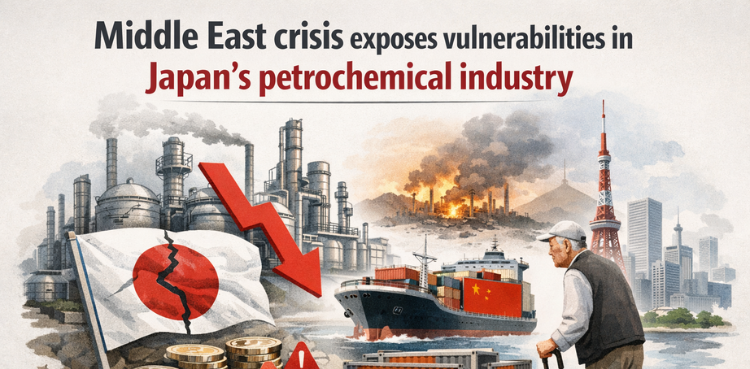
The active war in the Middle East has significantly impacted the petrochemical industries in Southeast Asia, which depends on naphtha crackers to offer the primary olefins and aromatics to help downstream chemical industries. The crisis has advanced the restructuring of the industry in the region, forced governmental interventions, restricted running rates, and reduced margins. Nowhere are the effect felt more intensely than in Japan – the fourth largest chemical manufacturer in the world (behind China, the US and Germany).
The nation’s petrochemical industry was having trouble even even before the present crises for many factors– some internal and structural, and others due the external market situations.
Japan is an ageing society with a falling population. Consumption of products that drive petrochemical demand see little growth, and except the demographics are altered through immigration – a remote possibility – the trends are improbable to reverse. The petrochemical industry is thus trapped in no-growth, high-cost structure environment.
The worldwide overcapacity, which has squeezed margins for the petrochemical industry almost anywhere, has effected Japanese corporations significantly due their high operating and capital costs. Early in the year, the US tariffs added uncertainty to exports to the nation. In different markets – Europe, the Middle East and rest of Asia – Japanese providers have been outmatched by Chinese providers diverting expanded volumes to compensate for loss of US business due punitive tariffs.
Falling output and ageing plants
Japan’s petrochemical industry also has a few fundamental weaknesses. Most petrochemical plants are based on imported naphtha – an high-priced feedstock, as compared to ethane (obtained from natural or shale gas). This makes manufacturers of primary ethylene derivatives such as polyethylene (PE), ethylene glycol (EG), vinyl intermediates and polyvinyl chloride (PVC), etc. vulnerable to cheap imports.
The nation’s peak ethylene manufacturing attained 7.7-mt way back in 2007 and has since been on a decline. As per the Japan Petrochemical Industry Association (JPCA), ethylene output in 2024 fell below 5-mt for the first time in 40 years. Installed capacity was about 6.2-mtpa, suggesting an abysmal operating rate of 80%. Moreover, overall manufacturing of 5 significant plastics – PE, polypropylene (PP), polystyrene (PS) and PVC – reduced by 4.7% to 6.02-mt in 2024.
Cracker sizes in Japan have also decline behind newer builds somewhere else. The largest in Japan has a capacity of most effective 750-ktpa, in comparison to at least 1.5-mtpa (and more) in other parts, at the same time as the smallest is just 375-ktpa. Most are old, which compromises procedure efficiencies, increased energy costs, and carbon footprints. The case for latest investments – rebuilds, modernisation, or incremental expansions – are hard to make within the wake of falling requirement, trapping the industry in an uncompetitive position.
Record low operating rate in March
The blockade of the Strait of Hormuz couldn’t have come at a worse time for Japan’s petrochemical industry.
The nation has 12 ethylene plants that crack naphtha. They import about 40% of their naphtha from the Middle East and depend on the place for 95% of the crude oil utilized in domestic refining, which supplies around 40% of its naphtha requirement. Procurement of both naphtha and crude oil had been significantly hampered.
JPCA currently reported that the utilization rate of ethylene plants fell to a record low of 68.6% in March (since records start in January 1996) – around the minimum of ~70% needed to sustain operations (even though this varies through plant). With 4 units present process scheduled maintenance, in comparison with none a year earlier, ethylene manufacturing in March totaled 272,600-tons, down 38.8% year-on-year. Moreover, shipments of essential ethylene-derived resins consisting of PE, PP and PS, had been nearly flat from a year earlier, supported via inventory drawdowns. Stocks of such main products stay sufficient to fulfill domestic demand for more than three months, with no instant risk of shortages, as per the associated officials. But must the effects of war persist longer – which could be the case although the war ceases nowadays – inventories will be reduced and supply shocks will pervade downstream and effect a broader set of consumers extensively in packaging of FMCG products.
Some companies had been shielded from the entire effects due their operations outside of Japan, and are evaluating transfer products from unaffected US operations, as an example, to cater to Japanese demand.
Regaining growth and profits
Japan’s chemical industry still has some levers to decrease costs and regain growth: switching feedstocks; rationalizing capacities; rejigging product portfolios to target on specialties; emphasizing decarbonization; and leveraging digitalization.
Switching from cracking naphtha to imported ethane is one way to enhance the cost position (by means of about $400 per tons ethylene, as per some estimates) however has so far not gain much momentum. The reasons are not unexpected: ethane use will need capex in the cracker to deal with the switch from naphtha and in the supply chain (terminals, ships, pipelines, etc.) to ferry it from supplier. Some who have evaluated the feedstock switch fear it’ll lessen availability of higher olefins and aromatics, effecting other value chains. While bad ancient margins have restricted the ability of the industry to do the switches, the present day crises might also force a reconsideration.
Numerous companies have mothballed or completely closed crackers in the last 5 years. Mitsubishi Chemical, one of the giants in Japan’s chemical industry, exited 10 businesses totaling $1.3-bn in annual sales among 2021 to 2023, and has plans to restructure an also 30, representing $2.7-bn in annual sales, from 2024 to 2029. Overall, closure of 4 crackers with a cumulative ethylene capacity of 1.8-mtpa have been introduced, as have permanent closures of intermediate and polymer plants. In April 2026, Mitsui Chemicals, Idemitsu Kosan Co. And Sumitomo Chemical received clearance from the Japan Fair Trade Commission to combine Sumitomo’s PP and linear low-density PE (LLDPE) companies into Prime Polymer Co., a joint venture among Mitsui and Idemitsu. The target isn’t just to improve operating rates for the plants that survive the cull, however also to enhance their competitiveness in a challenging business environment.
The most active measure being undertaken associated to realigning portfolios and transferring to high-cost specialities – a sector somewhere among basic petrochemicals and pharmaceuticals – that could offer higher profit margins and some resilience to market fluctuations. Japan’s consumers are amongst the most sophisticated within the world, and that is affording opportunities in high-tech chemical and material, including the ones require for electronics, semiconductors, renewable energy, communication devices, batteries, hydrogen-related ventures, agro- and life-science industries, among others. These need products of high quality, superior functionality, and sturdy reliability – functions that fit properly with Japanese corporate culture. In those segments, competitiveness is not determined by providing products at the lowest cost, but on offering solutions that resolve industry issues. Numerous chemical companies have proprietary technologies to head after these opportunities and are recasting management structures for these new forays that call for close collaboration, especially with clients.
Numerous strategies also are being taken – akin to that in Europe – to lessen the industry’s carbon footprint: carbon-neutral, biomass and recycling strategies; and initiatives to address with the plastic waste challenge. Companies operating steam crackers are looking to increase manufacturing of bio-based and recycled olefins & plastics by using incorporating bio-naphtha and recycled naphtha.
Companies are also deploying digital technologies – big data, artificial intelligence (AI), smart factories, and machine learning – to improve operational efficiencies, lower costs, and achieve better customer insights. Moreover, the industry’s classical mindset, rooted in well-set practices of the past, stays a stumbling block.
Sense of urgency
The Middle East war has severely exposed the vulnerabilities of Japan’s petrochemical industry to feedstock supply shocks. Efforts to geographically diversify sourcing of petrochemical feedstocks and primary energy sources, has taken a new urgency.
The industry is hoping that a rebalancing of petrochemical markets will happen in some point – perhaps by the middle of 2027 – and shore up margins. But there is also recognition that the essential forces presently shaping the petrochemical industry are here to stay, and a structural shift can be needed for the long-term survival of the industry in Japan.