
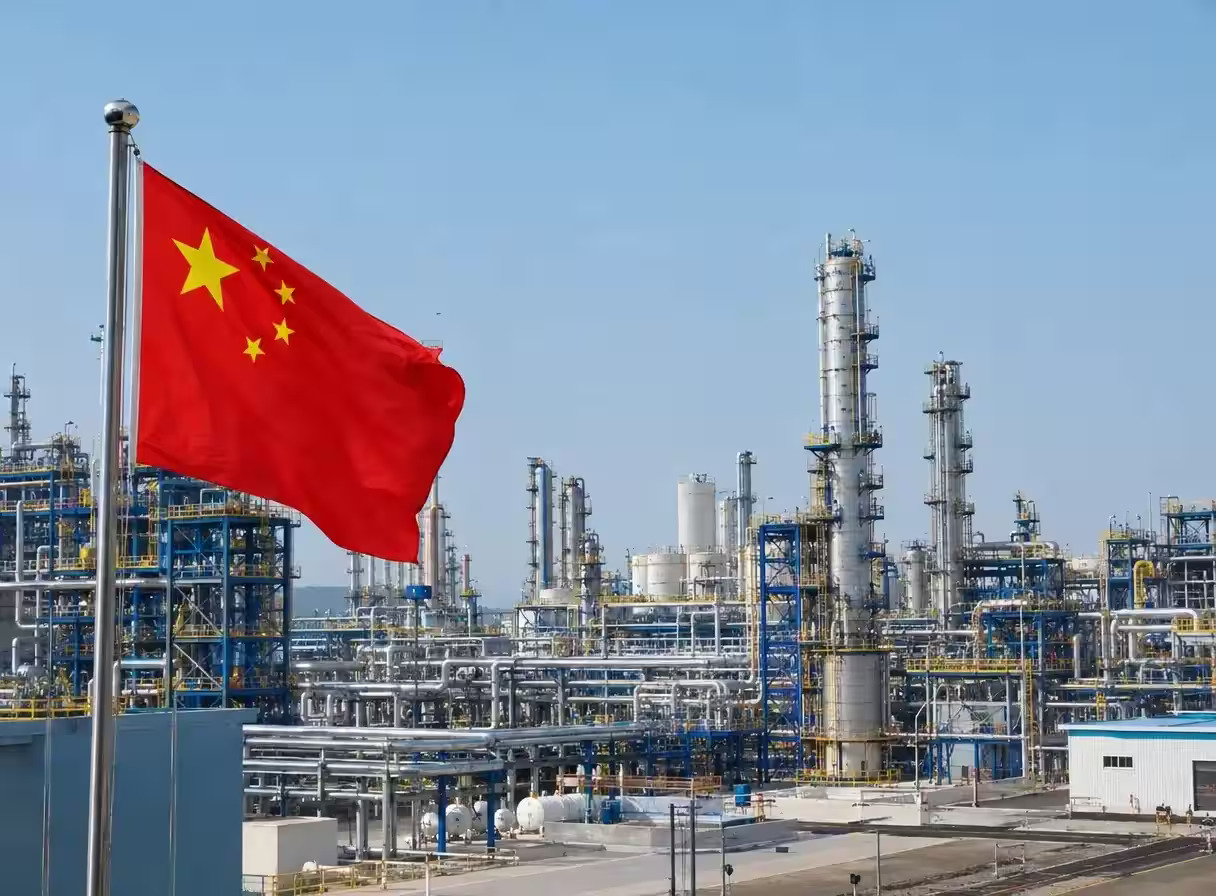
China’s fast-developing chemical industry is forming a worldwide supply glut that is pressuring foreign manufacturers in both domestic and export markets. A Rhodium Group report cited by The Tribune says the scale of expansion is now feeding lower prices, weaker margins and fresh trade friction, mainly in the US.
China’s chemical industry is no long just a domestic production story. It is forming pricing, trade flows and investment choices far beyond its borders, with foreign manufacturers feeling the strain both inside China and in export markets.
As per a report from the Rhodium Group cited by The Tribune, the country now accounts for more than 45% of world capacity for basic chemicals and plastic resins. The same report said China’s chemical output has expanded 18-fold over the past 25 years, a scale of growth that has left the sector with more supply than domestic demand can absorb.
Overcapacity is now a market issue, not just an industrial milestone
The result of that build-out is increasingly more seen in prices, inventories and margins. Rhodium Group stated the sector’s fast growth has formed excess capacity, which in turn has driven down prices, increased stockpiles and compressed profitability for Chinese producers. That pressure does not stop at China’s borders.
Foreign chemical manufacturers are being squeezed from two directions.
First, they are dropping sales in China as local producers replace imported products. Second, they’re confronting tougher competition overseas from Chinese exports. The report said the fall in China’s chemical imports has so far done more damage to foreign manufacturers than the rise in its exports, underlining how vital the domestic market has become for worldwide chemical companies.
US manufacturers are already responding with plant closures
The strain has started to show up in corporate restructuring in the United States. Houston-based Westlake Corporation said in December 2025 that it would shut 4 chemical manufacturing units in Louisiana and Mississippi, impacting about 295 employees. The facilities made products used in plastics and industrial materials, which include polyvinyl chloride, or PVC, that is broadly used in pipes and construction applications.
In a filing with the US Securities and Exchange Commission, Westlake connected the closures to global overcapacity and a wave of low-priced Asian exports that had pushed down prices for numerous chemical products. The company also said 3 of its North American units were no longer globally cost-competitive in export markets as production and transport costs have been too high. It added that it would exit styrene manufacturing as the export outlook was unfavourable.
The restructuring is anticipated to carry around $415 million in charges, although Westlake said the move should improve annual operating earnings over time. The company decision illustrates how pricing pressure in chemicals can fast translate into capital and employment decisions, particularly while export markets are already weak.
Beijing still wants growth, even as the sector slows
The Rhodium Group report traced the roots of China’s chemical growth to a long-running policy push to reinforce domestic production and reduce dependence on imported industrial inputs. That approach support build scale, but it also collided with a softer property market. Since 2021, weaker construction demand has decreased appetite for building-related chemicals simply as investment in new plants persisted to rise.
Even so, Beijing is not stepping back from the sector. The report pointed to a September 2025 industrial plan issued by seven Chinese government corporations that targets average annual growth of more than 5% in value added for the petrochemical and chemical industries during 2025 and 2026. The plan calls for curtailing some new capacity, upgrading current plants, developing higher-end products and pushing deeper into overseas markets.
Rhodium Group warned that these steps may improve efficiency without solving the core issue of surplus manufacturing. In other words, the sector may become productive, however not always less crowded.
Speciality chemical may be the next battleground
The report also flagged a shift in the competitive threat. Chinese manufacturers are probably more aggressively into speciality chemicals, a segment wherein foreign companies have traditionally enjoyed stronger margins and more technical differentiation. That might increase the stakes for overseas producers which have relied higher-value products to offset pressure in commodity chemicals.
For global manufacturers, the challenge is no limited to low-margin bulk products. If Chinese firms rise further up the value chain, competition ought to intensify in the very categories which have historically offered the high-quality profitability and the greatest insulation from price wars.
Trade remedies may help, however only partially
American companies also are looking for protection through trade action. On October 20, the USA Department of Commerce opened investigations into whether or not certain chemical compounds imported from China were being bought at unfairly low prices or were advantage from subsidies. The petitions were filed by New Jersey-based Evonik Corporation and Texas-based Huntsman International.
The products under review are amines, chemicals used across a range of industrial processes and quit products. The Commerce Department referred to alleged dumping margins starting from 244.94 consistent with cent to 352.32 in step with cent, even though those figures stay allegations under investigation instead of findings of wrongdoing.
The US International Trade Commission is due of vote on November 12 on whether there is an affordable indication that the imports are harming or threatening American producers. If the panel votes affirmatively, the cases will move forward.
Still, the report suggests that tariffs on individual products may not be sufficient to offset the wider competitive shift. Chinese chemicals can also reach global markets embedded in finished goods, even as foreign manufacturers persist to lose ground inside China itself. That makes the challenge structural instead of narrow, and much harder to resolve with one-off trade remedies.
For worldwide chemical companies, the message is clear: China’s scale benefit is no longer confined to its own market. It is reshaping competition everywhere from domestic supply chains to export routes, forcing manufacturers, regulators and investors to rethink how the industry will be priced and organised in the years ahead.