

Friday, August 14, 2026
hello@chemdive.com
Write for us
ChemDive - Unveiling the latest in the chemical world
No Result
View All Result
  • Home
  • World
  • Asia
  • America
  • Europe
  • MENA
  • Energy
  • Petrochemicals
  • Speciality Chemicals
  • Product ListHot
  • Home
  • World
  • Asia
  • America
  • Europe
  • MENA
  • Energy
  • Petrochemicals
  • Speciality Chemicals
  • Product ListHot
No Result
View All Result
ChemDive - Unveiling the latest in the chemical world
No Result
View All Result
Home Latest News

Review describes Advances in Chemical Looping for Low-Carbon Fuel Production

Taanvi Sawhnay by Taanvi Sawhnay
January 19, 2026
in Latest News
Reading Time: 2 mins read
0
A A
0
Review describes Advances in Chemical Looping for Low-Carbon Fuel Production

Photo Credit: https://www.chemicalprocessing.com/

Progress in fluidized-bed reactors and oxygen carrier design ought to improve hydrogen and chemical manufacturing even as reducing emissions, as per the latest research.

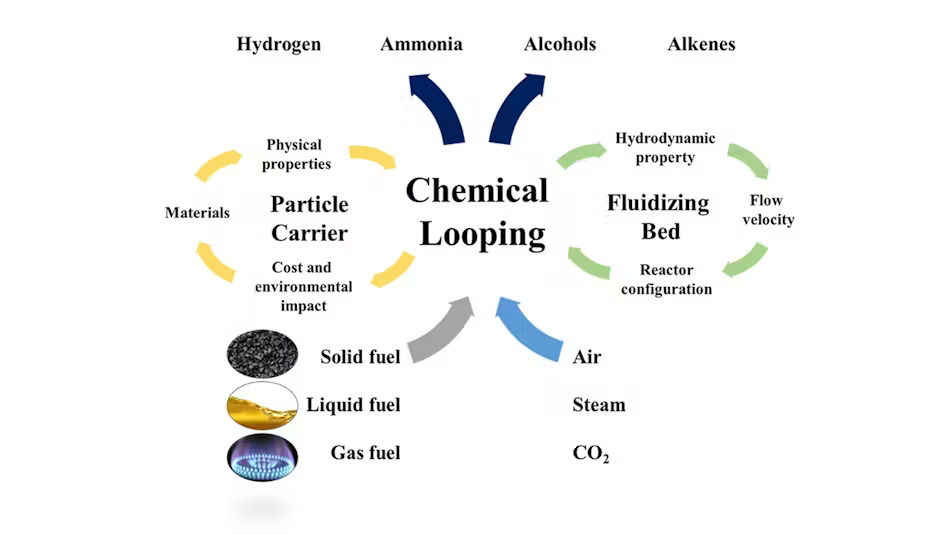
Researchers at Jeonbuk National University, South Korea, have posted a comprehensive overview analyzing current advances in chemical looping technologies, emphasizing how upgradations in fluidized-bed reactor design and oxygen carrier materials could assist lower-carbon hydrogen and chemical manufacturing.

Chemical looping is an evolving process that uses of cyclic oxidation and reduction of metal oxide particles in fluidized-bed reactors to permit fuel conversion with inherent carbon dioxide separation.

Also Read :

BASF advances restructuring, acquiring stronger market foothold

Sorbitan Esters and Polysorbates: The Backbone of Food and Cosmetic Emulsification

Dow posts sharp profit rebound as higher prices, self-support drive second-quarter earnings

Iraq, Syria ink deals with Qatar’s UCC, Chevron and TI Capital for cross-border oil pipeline to the Mediterranean

As per the authors, current developments have increased the range of applications for chemical looping systems, together with reforming, gasification and hydrogenation techniques. “Our work emphasizes key advancements in fluidized-bed reactors that improve reforming, gasification, and hydrogenation within chemical looping systems,” stated Jester Lih Jie Ling, who led the research. “It also highlights improved oxygen carrier materials with higher reactivity, durability, and resistance—important attributes for long-term, strong operation.”

The review, posted in Renewable Energy, outlines overall performance criteria for oxygen carrier and bed materials, including oxygen vacancy behavior, fuel or feedstock compatibility, carbon deposition, particle agglomeration, and economic and environmental consideration. The authors note that advances in reactor design now permit chemical looping systems to procedure liquid and solid feedstocks in addition to gases, broadening their industrial relevance.

From a materials attitude, the researchers report that oxygen carrier structure and synthesis processes considerably impact chemical yield and product purity. The review evaluates usually used preparation strategies, consisting of sol-gel processing, spray drying, impregnation, co-precipitation and freeze granulation, and assesses their impact on carrier performance during repeated redox cycles.

The paper also examines a range of oxygen carrier compositions, consisting of perovskite, spinel and core-shell structures, as well as copper-, iron-, nickel- and manganese-based totally materials. These carriers were evaluated for applications such as hydrogen manufacturing by steam reforming and water splitting, ammonia synthesis via nitrogen looping, and the manufacturing of syngas-derived fuels, light olefins and selective oxidation products.

In addition to materials selection, the authors highlight the significance of fluidization control and particle-scale modeling to optimize yields and maintain reactor stability. The review identifies thermal and chemical stress–associated particle degradation as a main area for future research.

“The implementation of chemical looping processes in fluidized bed reactors is in alignment with the rising demand for sustainable and low carbon renewable energy technologies,” Ling said in a declaration. “Overall, this review is predicted to guide the further development of chemical looping fluidized bed reactors.”


ShareTweetShareShareSend
Taanvi Sawhnay

Taanvi Sawhnay

I’m Taanvi Sawhnay, known as Tan, a professional blogger with a deep interest in the global chemical industry. I’ve spent years writing for various platforms, delivering insightful analysis and up-to-date news. At ChemDive, I share my knowledge and passion, making complex industry trends accessible to professionals, academics, and enthusiasts alike. My goal is to engage readers with clear, informative content while keeping them informed about the latest developments in the chemical world.

Related Posts

How the Biotechnology Industry Is Driving Innovation in Drug Development
Latest News

How the Biotechnology Industry Is Driving Innovation in Drug Development

July 20, 2026
0
How PCE Superplasticizers Improve Concrete Performance in Modern Construction Chemicals
Latest News

How PCE Superplasticizers Improve Concrete Performance in Modern Construction Chemicals

July 10, 2026
0
Crude Oil Price Trend: Why Every Price Swing Matters More Than You Think
Latest News

Crude Oil Price Trend: Why Every Price Swing Matters More Than You Think

July 1, 2026
0
Evonik to cut 3,200 jobs in sweeping restructuring amid intensifying cost pressures
Europe

Evonik to cut 3,200 jobs in sweeping restructuring amid intensifying cost pressures

June 19, 2026
0
Corrosion in oil and gas systems demands integrated chemical strategy, experts warn
Latest News

Corrosion in oil and gas systems demands integrated chemical strategy, experts warn

June 18, 2026
0
Carbon Black Market: Key Trends, Uses, and Future Industry Growth
Latest News

Carbon Black Market: Key Trends, Uses, and Future Industry Growth

June 16, 2026
0

Leave a Reply Cancel reply

Your email address will not be published. Required fields are marked *

Categories

  • America
  • Asia
  • Energy
  • Europe
  • Events
  • Inventions
  • Latest News
  • MENA
  • Petrochemicals
  • Speciality Chemicals
  • World

PTT Global Chemical stands firm and aims new growth chapter

European chlorine manufacturing falls 3.9% in June as output slips from May peak

Illinois Tightens Plastic Pellet Spill Rules for Chemical Producers

Epsilon Carbon commissions 300,000-TPA specialty carbon plant in Karnataka

LANXESS turns to hydrogen to slash emissions at Krefeld-Uerdingen

Catalyxx to built its first commercial renewable chemicals plant in Portugal

About ChemDive

ChemDive is a premier platform providing up-to-date global chemical news, industry insights, and in-depth analysis of trends shaping the chemical sector. It serves as a comprehensive resource for professionals, researchers, and enthusiasts, offering coverage on innovations, regulations, market developments, and technological advancements in the chemical industry. 

Quick Links

  • About Us
  • Privacy Policy
  • Write for Us
  • Terms & Conditions
  • Contact Us

Contact Us

Email: hello@chemdive.com

Designed & Managed by AK Network Solutions

Welcome Back!

Login to your account below

Forgotten Password?

Retrieve your password

Please enter your username or email address to reset your password.

Log In
No Result
View All Result
  • Home
  • World
  • Asia
  • America
  • Europe
  • MENA
  • Energy
  • Petrochemicals
  • Speciality Chemicals
  • Product List

© 2024. Designed & Developed by AK Network Solutions

This website uses cookies. By continuing to use this website you are giving consent to cookies being used. Visit our Privacy and Cookie Policy.