
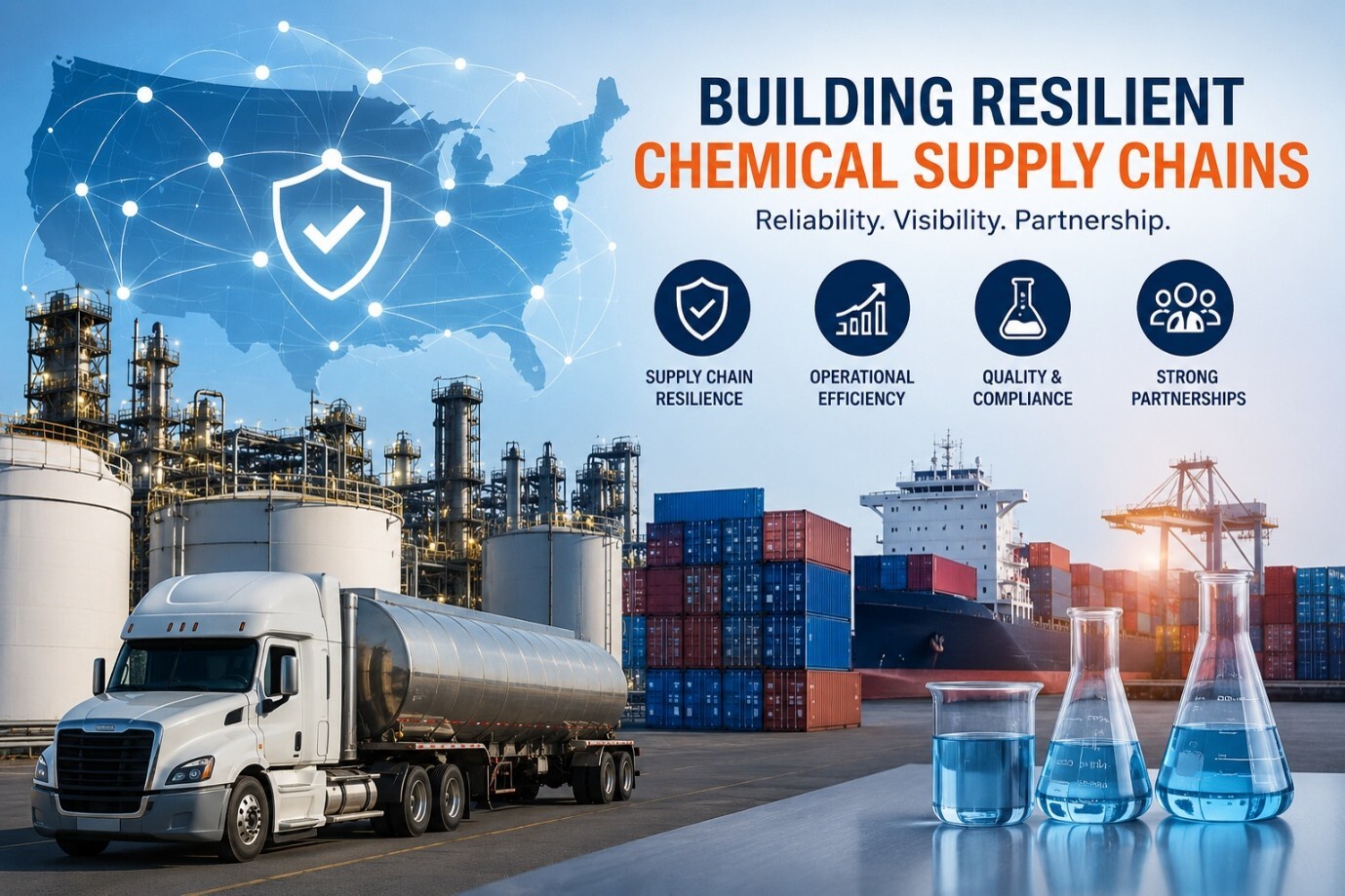
The U.S. specialty chemical industry has entered a new era. Over the past several years, manufacturers have faced unprecedented challenges—from global supply chain disruptions and transportation bottlenecks to raw material shortages, geopolitical uncertainty, and evolving regulatory requirements. These events have fundamentally changed how manufacturers evaluate suppliers and manage procurement strategies.
Today, resilience has become just as important as price.
Rather than focusing solely on securing the lowest-cost raw materials, manufacturers are increasingly seeking supply partners capable of delivering consistency, technical expertise, regulatory support, and operational reliability. As a result, supply chain resilience is no longer simply a logistics concern—it has become a strategic competitive advantage across the specialty chemical industry.
From Cost Optimization to Risk Management
For decades, many organizations optimized their supply chains by reducing inventory, consolidating suppliers, and sourcing globally to minimize costs. While these approaches improved efficiency under stable market conditions, recent disruptions exposed significant vulnerabilities.
Transportation delays, limited container availability, port congestion, and interruptions in global manufacturing demonstrated how quickly a single disruption could affect production schedules, customer commitments, and profitability.
Manufacturers are now balancing cost efficiency with risk reduction by diversifying suppliers, increasing domestic sourcing, and strengthening relationships with dependable distribution partners.
This shift is transforming procurement from a transactional function into a strategic component of long-term business resilience.
Why Reliability Matters More Than Ever
Specialty chemicals play a critical role across industries including personal care, food and beverage, coatings, industrial manufacturing, water treatment, agriculture, pharmaceuticals, and metal finishing.
Unlike commodity materials, specialty chemicals often require strict quality specifications, application expertise, and regulatory documentation. Even minor inconsistencies can affect product performance, production efficiency, or customer satisfaction.
Reliable supply therefore extends beyond product availability. Manufacturers increasingly evaluate suppliers based on their ability to provide:
- Consistent product quality
- Comprehensive documentation, including Safety Data Sheets (SDS) and Certificates of Analysis (COA)
- Transparent communication during supply disruptions
- Technical application support
- Regulatory knowledge
- Responsive customer service
- Flexible inventory and logistics capabilities
These capabilities help manufacturers maintain production continuity while reducing operational risk.
The Growing Importance of Domestic Supply Networks
Recent market disruptions have accelerated interest in strengthening domestic and regional supply chains.
For many manufacturers, working with U.S.-based suppliers offers several advantages:
- Reduced transportation complexity
- Shorter lead times
- Improved communication
- Better inventory visibility
- Faster technical support
- Greater flexibility when responding to changing production requirements
While international sourcing remains an important part of the global chemical industry, many organizations are now adopting hybrid sourcing strategies that combine global procurement with dependable regional distribution partners.
This approach improves resilience while helping manufacturers respond more effectively to market uncertainty.
Technical Expertise Has Become a Competitive Differentiator
Modern specialty chemical suppliers are increasingly expected to provide more than products.
As formulations become more sophisticated and regulatory requirements continue to evolve, manufacturers often rely on supplier expertise throughout product development and commercialization.
Technical support may include:
- Ingredient selection
- Formulation guidance
- Product substitution recommendations
- Performance optimization
- Application troubleshooting
- Regulatory documentation
- Process improvement recommendations
These collaborative relationships reduce development timelines while helping customers improve efficiency and product performance.
Rather than acting solely as distributors, many specialty chemical suppliers have become long-term technical partners.
Sustainability Is Influencing Procurement Decisions
Environmental responsibility has become an increasingly important consideration across the chemical industry.
Brand owners, manufacturers, and consumers are placing greater emphasis on responsibly sourced raw materials, renewable feedstocks, improved manufacturing efficiency, and reduced environmental impact.
This trend has accelerated demand for:
- Naturally derived ingredients
- Renewable alternatives
- Biodegradable chemistries
- Efficient manufacturing processes
- Sustainable supply chain practices
At the same time, manufacturers continue to prioritize performance, consistency, and regulatory compliance, making supplier expertise increasingly valuable when evaluating alternative raw materials.
Digital Transformation Is Improving Supply Chain Visibility
Digital technologies are also reshaping specialty chemical distribution.
Advanced inventory management systems, real-time logistics tracking, predictive demand forecasting, and digital documentation have significantly improved transparency throughout the supply chain.
These capabilities allow manufacturers to:
- Monitor inventory levels more effectively
- Improve production planning
- Reduce procurement delays
- Respond more quickly to supply interruptions
- Improve communication across procurement, production, and logistics teams
As digital adoption continues to grow, supply chain visibility is expected to become a defining characteristic of high-performing chemical suppliers.
Building Long-Term Partnerships
One of the most significant shifts within the specialty chemical industry is the growing emphasis on long-term collaboration.
Successful manufacturers increasingly seek suppliers who understand their production processes, quality requirements, regulatory obligations, and business objectives.
Strong partnerships are built on:
- Trust
- Transparency
- Technical collaboration
- Reliable communication
- Consistent product quality
- Responsive service
When suppliers and manufacturers work collaboratively, both organizations become better positioned to respond to changing market conditions and customer expectations.
Looking Ahead
The U.S. specialty chemical industry will continue to evolve as manufacturers adapt to changing regulations, technological innovation, sustainability goals, and global market dynamics.
Organizations that invest in resilient supply chains today will be better prepared for tomorrow’s challenges.
Supply resilience is no longer measured solely by warehouse inventory or transportation capacity. It is built through strong supplier relationships, technical expertise, operational flexibility, and a shared commitment to continuous improvement.
As manufacturers evaluate future sourcing strategies, reliability, responsiveness, and collaboration will remain essential factors in achieving long-term operational success.
About the Author
California Chemical is a U.S.-based specialty chemical manufacturer, supplier, and distributor serving industries including personal care, industrial manufacturing, food & beverage, agriculture, water treatment, coatings, and metal finishing. By combining dependable supply, technical expertise, and customer-focused service, California Chemical helps manufacturers build more resilient and efficient supply chains.
Learn more at https://californiachemical.com