

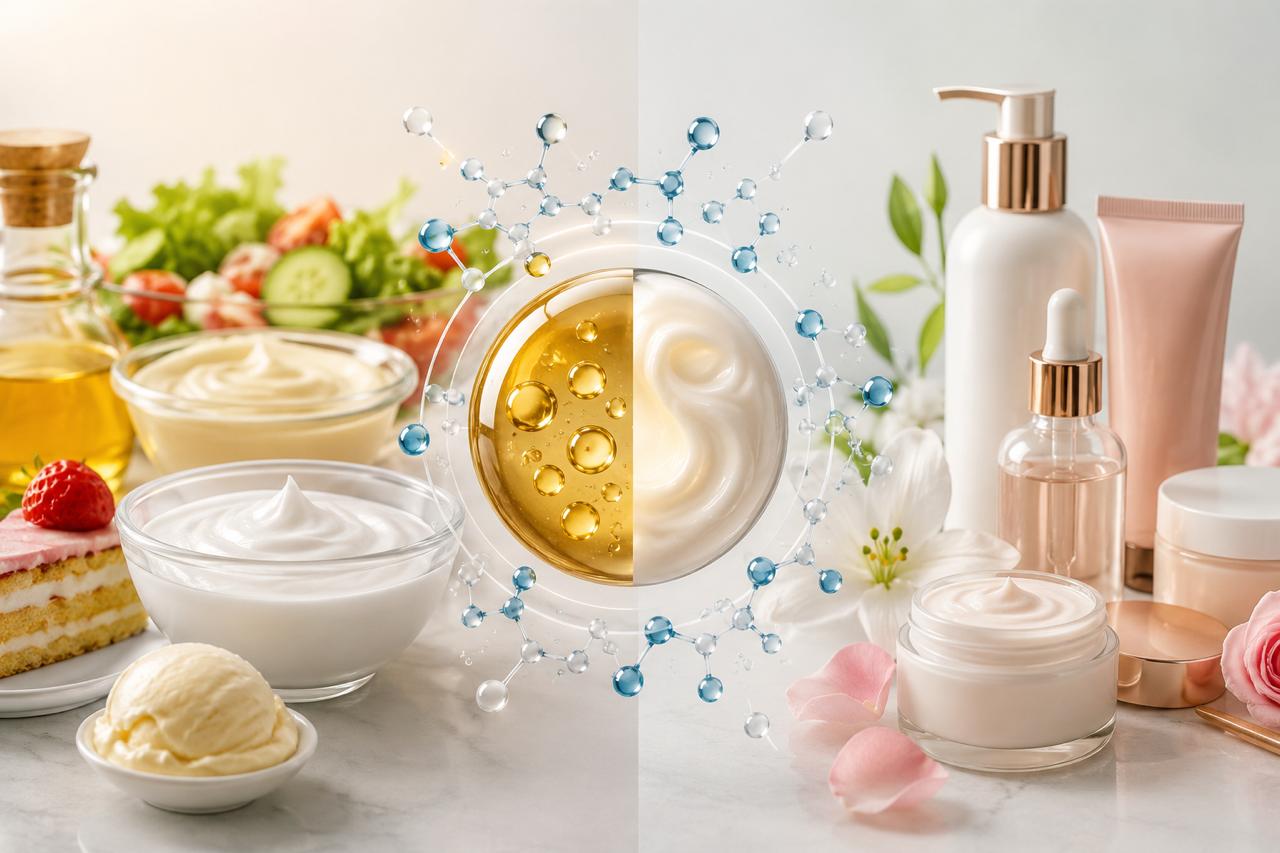
Oil and water do not mix — yet a jar of mayonnaise, a scoop of ice cream, and a bottle of body lotion all depend on getting them to do exactly that. The invisible workhorses that hold these products together are emulsifiers, and among the most versatile in the global market are two closely related families: sorbitan esters and polysorbates. Between them, they stabilise a remarkable share of the food and personal-care products sitting in kitchens and bathrooms worldwide.
This article looks at what these molecules are, how they differ, why formulators reach for them so often, and the questions researchers are now asking about their long-term use.
What Are Sorbitan Esters?
Sorbitan esters are produced by reacting sorbitan — a cyclic compound derived from the dehydration of sorbitol, a sugar alcohol — with fatty acids such as lauric, palmitic, stearic, or oleic acid. The result is a family of non-ionic surfactants that are predominantly oil-loving (lipophilic).
Commercially, sorbitan esters are widely recognised under the trade name Span. The most common grades include:
- Sorbitan monolaurate (Span 20, food code E493)
- Sorbitan monopalmitate (Span 40, E495)
- Sorbitan monostearate (Span 60, E491)
- Sorbitan monooleate (Span 80, E494)
- Sorbitan tristearate (Span 65, E492)
Because they are mostly lipophilic, sorbitan esters carry a low HLB value (Hydrophilic-Lipophilic Balance, a scale from roughly 0 to 20 that describes a surfactant’s affinity for oil versus water). Span 80, for example, sits around an HLB of 4.3. Low-HLB emulsifiers are best suited to stabilising water-in-oil (W/O) systems, where water droplets are dispersed inside a continuous oil phase.
What Are Polysorbates?
Polysorbates start from the same sorbitan-ester backbone but add one crucial modification: ethoxylation. Chains of ethylene oxide are grafted onto the molecule, dramatically increasing its water solubility. This shifts the balance from oil-loving to water-loving.
Polysorbates are marketed under the Tween name and identified by a number that corresponds to their sorbitan-ester parent:
- Polysorbate 20 (Tween 20, E432) — ethoxylated sorbitan monolaurate
- Polysorbate 60 (Tween 60, E435) — ethoxylated sorbitan monostearate
- Polysorbate 80 (Tween 80, E433) — ethoxylated sorbitan monooleate
The added polyoxyethylene chains push polysorbates to a high HLB value — Polysorbate 80 registers around 15. High-HLB emulsifiers excel at stabilising oil-in-water (O/W) systems, the arrangement found in most lotions, creams, and beverages, where oil droplets are suspended in a continuous water phase.
In short: sorbitan esters and polysorbates are two ends of the same chemical family. One is oil-friendly, the other water-friendly, and that complementary relationship is precisely what makes them so useful together.
The HLB Principle: Why Formulators Pair Them
One of the most elegant tricks in emulsion science is combining a low-HLB sorbitan ester with a high-HLB polysorbate to hit a specific target value. Every oil phase has a “required HLB” — the balance point at which it emulsifies most efficiently. By blending, say, Span 60 and Tween 60 in the right ratio, a formulator can dial in almost any intermediate HLB and produce a far more stable emulsion than either surfactant would achieve alone.
This pairing delivers several practical benefits:
- Superior emulsion stability across a range of temperatures
- Finer, more uniform droplet size, which improves texture and shelf life
- Formulation flexibility, since the ratio can be tuned to different oils
- Reliable, reproducible results in large-scale manufacturing
It is this tunability, more than any single property, that has made the Span/Tween system a default toolkit for emulsion chemists for decades.
Applications in Food
In the food industry, sorbitan esters and polysorbates are prized for controlling texture, extending shelf life, and improving mouthfeel. Typical uses include:
- Ice cream and frozen desserts, where they promote smooth texture and control ice-crystal growth
- Bakery products, improving dough handling, crumb structure, and softness
- Chocolate and confectionery, aiding viscosity control and gloss
- Whipped and non-dairy toppings, stabilising the aerated structure
- Emulsified sauces and dressings, keeping oil and water phases integrated
Their non-ionic nature — meaning they carry no electrical charge — makes them compatible with a wide range of other ingredients and relatively insensitive to pH and salt, a valuable trait in complex food matrices.
Applications in Cosmetics and Personal Care
In cosmetics, the same chemistry underpins the stable, pleasant textures consumers expect. Sorbitan esters and polysorbates appear in:
- Creams and lotions, as primary or co-emulsifiers for O/W and W/O systems
- Cleansers and micellar waters, where polysorbates help solubilise oils and fragrances into water
- Makeup and colour cosmetics, dispersing pigments evenly
- Fragrance solubilisation, dissolving small amounts of essential oil into clear aqueous products
Polysorbate 80 and Polysorbate 20 in particular are go-to solubilisers when a formulator needs to dissolve an oily active or fragrance into an otherwise water-based product without clouding it.
Beyond food and cosmetics, Polysorbate 80 is also one of the most widely used excipients in pharmaceutical formulations, where it stabilises and solubilises injectable and oral drugs — a testament to how well characterised and versatile the molecule is.
Emerging Research and the Safety Conversation
Sorbitan esters and polysorbates are long-established additives that regulatory bodies have permitted within defined limits for many years. That established status, however, has not stopped scientists from taking a fresh look.
Over the past decade, a growing body of research has examined how certain dietary emulsifiers interact with the gut microbiome. Studies — many conducted in mouse models and in laboratory (in-vitro and ex-vivo) gut simulators — have reported that Polysorbate 80, alongside carboxymethylcellulose, can alter microbial composition and affect the intestinal mucus layer in ways associated with low-grade inflammation. A 2024 review in Communications Biology summarised how several common emulsifiers may influence metabolic and inflammatory markers under experimental conditions (Nature, Communications Biology, 2024).
It is worth keeping this in perspective. Much of the evidence comes from animal or model systems, often at doses that may not reflect ordinary dietary intake, and human data is still emerging. Rather than a verdict against these ingredients, the research reflects a broader scientific push to re-evaluate food additives through the lens of microbiome science. For formulators and manufacturers, the practical takeaway is clear: stay current with the evolving literature, work within regulatory limits, and choose grades and suppliers with robust quality documentation.
Conclusion
Sorbitan esters and polysorbates may be invisible on a label to most consumers, but they are foundational to modern formulation. Their complementary chemistry — one lipophilic, one hydrophilic, both tunable through the HLB principle — gives food technologists and cosmetic chemists a dependable way to make oil and water coexist in a stable, appealing product. As microbiome research continues to mature, the conversation around these emulsifiers will keep evolving, but their central role in emulsification is unlikely to fade any time soon.
Author Bio
Ruchit Jani is the CMD of Matangi Industries and a seasoned expert in manufacturing of performance chemicals, Oil & Gas chemicals, custom synthesis, and more.